Zalo Icon
Zalo Icon

Case Study

Resources > Case Study > 3> Payment email automation: 80% less processing time, 90% fewer errors


Payment email automation: 80% less processing time, 90% fewer errors

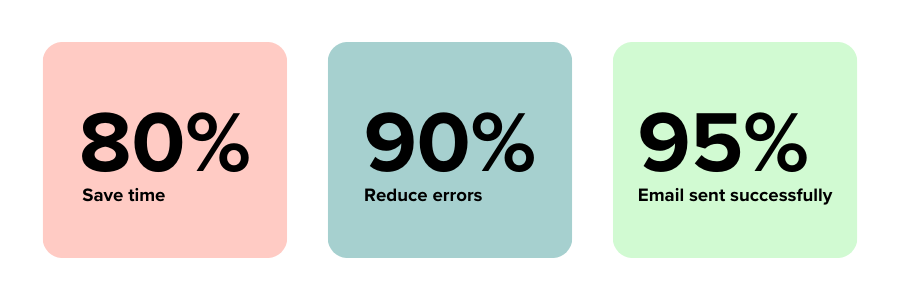
Automating payment request emails gives finance teams back the hours they spend on sending — and removes the errors that manual sending creates. In this project, AFusion deployed a payment email automation solution with RPA that saved the client up to 80% of the time previously spent on payment emails, cut related errors by up to 90%, and reached a 95% email success rate. The whole deployment took one month with a team of 2.

What payment email automation changes for a finance team

Payment emails sit at an important point in the order-to-cash cycle: they carry invoices and payment details to customers, and their accuracy and timing directly affect when money arrives and how the company looks to its customers. Done manually at volume, the process creates three predictable costs:
  • Repetitive work crowds out strategic work. The accounting team sends payment emails daily. The manual routine costs hours, and when people are tied up with repetitive sending, higher-value work — financial analysis, management reporting — gets delayed or skipped, with knock-on effects on other tasks.
  • Errors are frequent and expensive. Manual sending produces entry mistakes, wrong content, and incorrect payment details. With batches of invoices and detailed requirements attached, even small errors can distort financial results and damage customer relationships.
  • Consistency and tracking are hard to guarantee. Making sure every payment email goes out complete and correct is difficult at volume. Without automatic tracking, gaps and discrepancies appear in the payment process — and partners notice.
That is the cost side. The benefit side is what this project delivered: the same daily volume of payment emails, sent on time and correctly, with a full record behind every one of them — and the team’s time returned to work that needs judgment.
Effortless Billing Email Automation For Businesses

What the customer wanted

The customer wanted a billing automation solution that sends every invoice and payment notice to customers swiftly, accurately, and consistently, minimizing errors caused by repetitive manual tasks — while meeting security and compliance standards.

How AFusion implemented it

AFusion implemented the payment email automation within one month, with 2 staff. The robot reads the booking list from Dropbox, finds the payment documents belonging to each booking, and sends the payment email to the customer on time. The implementation ran in three steps:

Technologies Used by AFusion

1. Gather business requirements

AFusion collected requirements from the customer to understand the process precisely: how often payment emails must go out, what each email must contain, and which documents accompany each payment request.

2. Build the automation robot

With requirements fixed, AFusion built the robot for the payment email process. The robot accesses the booking management system, retrieves the details of each booking, composes a personalised payment email with the correct documents, and sends it.

3. Deploy and maintain

The robot was deployed into the customer’s live process with regular maintenance. AFusion monitors performance and adjusts the robot as business requirements change, so the automation keeps up with the process instead of falling behind it.


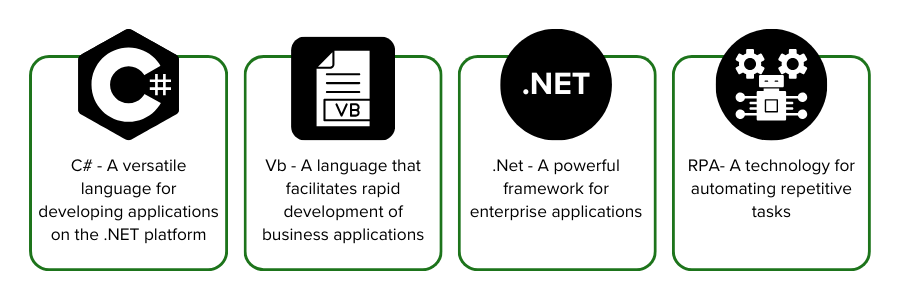
The technology behind this payment automation solution: C#, VB, .NET, and RPA.

Results achieved

Achieved Results
  • 80% of time saved. The automation removed most of the repetitive manual work, saving the client up to 80% of the time previously spent sending payment emails. Staff stopped doing routine sending and moved to complex, strategic, higher-value work such as financial data analysis and management reporting. Team productivity rose visibly, and day-to-day pressure dropped.
  • 90% fewer errors. Errors in the manual payment email process fell by up to 90%. Wrong data entry and misdirected emails are now almost nonexistent — credibility-enhancing in accounting, where accuracy maintains customer trust and keeps the company compliant with financial regulations. Accurate figures also make downstream planning decisions sound.
  • Consistency, synchronization, and full tracking. The automated system records and stores the history of every email sent. The business can track payment statuses, check details on demand, and produce more effective reports. Emails arrive consistently on time, which maintains customer relationships and increases transparency across financial transactions — with a send success rate of up to 95%.
The pattern behind these numbers: payment email automation does not only make an existing task faster. It removes the task from human hands, then returns the capacity, the accuracy, and the audit trail to the finance team at the same time.

Where could automation give your team its hours back?

Payment emails are one of the most automatable tasks in a finance department: rule-based, high-volume, document-heavy, and already happening every day. But the same logic applies across the order-to-cash and procure-to-pay cycles — invoice data entry, reconciliation, statement distribution, payment matching. If your team spends its mornings moving data between systems and its afternoons checking what the mornings moved, that is a process worth mapping. AFusion surveys finance workflows, identifies which routines automation can absorb first, and shows what the time saved is worth in numbers before you commit to anything. A short workflow review is usually

Frequently asked questions

What is payment email automation?

A software robot that handles the sending of payment request emails end to end: it reads booking or order data, assembles the correct invoice and payment documents, composes each email, sends it on schedule, and logs every send for later tracking.


How much time does automated payment reminder processing actually save?

In this project, the client saved up to 80% of the time previously spent on manual payment email processing, with related errors down by up to 90% and a send success rate of up to 95%. Actual results depend on email volume and how standardized the documents are.


Does automated sending still allow human control?

Yes. The requirements phase defines exactly what the robot may send and when. AFusion keeps monitoring after deployment and adjusts the robot when business rules change, so humans own the rules while the robot owns the repetition.


How long does a payment email automation project take?

This deployment took one month with a team of 2 — requirements gathering, robot build, deployment, and maintenance setup. More complex document pipelines (multiple systems, varying formats) take longer.

Comments are closed.